
FBA Shipping: How does Amazon FBA work – Fulfillment by Amazon
As more consumers turn to online shopping for convenience and speed, Amazon continues to dominate the e-commerce space, making it the go-to platform for aspiring entrepreneurs and established businesses alike.
With two out of three U.S. consumers shopping on Amazon, and a growing number of loyal Prime members, the marketplace presents an unparalleled opportunity for sellers. According to recent data, 51% of American consumers begin their product searches on Amazon, and over half say that if they could only shop at one store, they’d choose Amazon.
Despite ongoing economic uncertainty, including inflation and market shifts, e-commerce remains resilient — and Amazon is leading the charge. In 2022, Amazon accounted for 38% of total U.S. e-commerce sales, making it the largest online retailer in the country.
How does Amazon FBA work?Amazon FBA calculator Amazon FBA vs dropshipping fulfillment centers Amazon FBA calculator What is Fulfillment by Amazon (FBA)? – Definition Pro |Cons How does Amazon FBA work?
Why Choose Rapid Express Freight for FBA Shipping?

FBA Amazon is one of the most popular ways to build an online business, making it easier for sellers to store, pack, and ship products through Amazon's fulfillment network. If you're exploring Amazon FBA for beginners, it's important to understand how does Amazon FBA work, including how inventory is sent to Amazon warehouses and fulfilled when customers place orders. Before getting started, you'll also want to know about the Amazon FBA monthly fee and FBA fulfillment fees, which can impact your overall profitability. Whether you're signing up as an Amazon FBA individual seller or growing a larger business, understanding services like an Amazon FBA removal order for unsold inventory is essential. Many new entrepreneurs also compare Amazon FBA vs dropshipping to determine which business model best fits their goals, budget, and long-term growth strategy.
Fast Transit Times: Get your products to Amazon fulfillment centers quickly to avoid storage delays and stockouts.
Amazon-Compliant Packaging & Labeling: We ensure your shipments meet Amazon’s strict requirements for packaging, labeling, and documentation.
Competitive Freight Rates: Save on shipping costs without compromising on speed or reliability.
Full Tracking & Support: Stay informed every step of the way with real-time shipment tracking and dedicated customer support.
Nationwide & International Shipping: Whether you’re shipping domestically or from overseas, we handle logistics efficiently.
Prepare your inventory following Amazon’s FBA guidelines.
Schedule your shipment with Rapid Express Freight.
We pick up your products and transport them securely.
Your inventory arrives on time at Amazon’s fulfillment centers, ready for fast order processing.
Optimize your FBA shipping process and keep your Amazon business running smoothly with Rapid Express Freight. Fast, reliable, and hassle-free logistics designed specifically for Amazon sellers.
Recent behavior trends underscore Amazon's staying power:
57% of U.S. consumers now shop on Amazon weekly or more
18% say they purchase from Amazon 2–3 times per month
Consumers consistently cite speed, reliability, and trust as reasons for their loyalty
Amazon's Fulfillment by Amazon (FBA) program offers a seamless entry point for new sellers. With FBA, sellers ship inventory directly to Amazon’s fulfillment centers. From there, Amazon handles storage, order fulfillment, shipping, and customer service — including Prime-eligible 2-day delivery.
“Selling online has never been more accessible,” said [Spokesperson Name], [Title] at [Company Name]. “With Amazon’s infrastructure, sellers don’t need a warehouse or customer support team. FBA levels the playing field, allowing individuals and small businesses to scale quickly.”
To help new sellers take advantage of this opportunity, [Your Company/Organization] has released a FREE resource:“Guide to Selling on Amazon” – covering everything from product selection and shipping requirements to FBA setup and marketing tips.
Key Points:
FBA is ideal for:
Sellers who want to scale quickly
Businesses that value convenience over control
Products with consistent turnover and strong demand
It may not be ideal for:
Low-margin products
Items with slow sales velocity
Sellers wanting more control over branding and packaging
Fulfillment by Amazon (FBA) is a service offered by Amazon that allows third-party sellers to store their products in Amazon's fulfillment centers. Amazon then takes care of the storage, packaging, shipping, customer service, and returns for those products.
In other words, with FBA, sellers send their inventory to Amazon, and Amazon handles the rest — including Prime delivery, making it easier for sellers to reach more customers and scale their business.

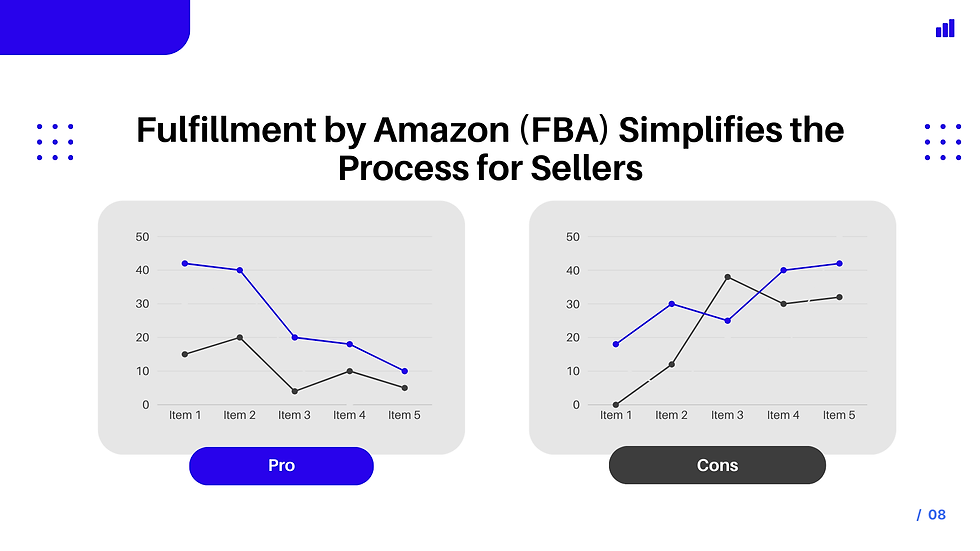
Graph Breakdown by Role:
Your products become Prime-eligible, which boosts trust and sales
Amazon offers fast shipping, improving the customer experience
You get access to Amazon’s customer service and return handling
You can scale your business more easily without owning a warehouse
Step | Who Handles It | What Happens |
You List Product on Amazon | Seller | Add product to Amazon marketplace |
Send Inventory to Amazon | Seller | Ship inventory to Amazon fulfillment warehouse |
Store Inventory | Amazon | Amazon stores products in its warehouse |
Customer Buys Product | Customer | Customer places order on Amazon |
Pick, Pack, and Ship | Amazon | Amazon processes the order and ships it out |
Customer Support & Returns | Amazon | Amazon handles all post-sale service |
Pros of FBA
Advantage | Description |
Prime Eligibility | Your products become eligible for Amazon Prime, increasing visibility and trust. |
Fast, Reliable Shipping | Amazon handles 1-2 day shipping, improving customer satisfaction. |
Hands-off Fulfillment | No need to manage warehousing, packing, or shipping yourself. |
Customer Service Included | Amazon handles inquiries and returns, saving time and effort. |
Scalability | Easily scale operations without investing in logistics infrastructure. |
❌ Cons of FBA
Disadvantage | Description |
Fees Can Add Up | Fulfillment, storage, and other fees can cut into your profit margins. |
Less Branding Control | Amazon handles packaging, so there’s limited room for custom branding. |
Storage Limits & Fees | Long-term storage fees apply to unsold items; space may be limited seasonally. |
High Return Rates | Easy returns for buyers can mean more returns (and restocking costs) for you. |
Less Operational Control | Amazon controls much of the process — including customer communication. |
Amazon FBA | Dropshipping |
Entrepreneurs with capital who want to build a scalable e-commerce business leveraging Amazon's reach. | Beginners with limited capital who want to test products and learn e-commerce with low risk. |
Which Should You Choose?
Choose Amazon FBA if:
You have $3,000–$10,000+ to invest.
You want to build a long-term brand.
You're okay with upfront risk.
Choose Dropshipping if:
You're starting with <$1,000.
You want to learn e-commerce with minimal risk.
You're okay with lower profits and testing many products.
Frequently Asked Questions (FAQ)
Using the FBA Revenue Calculator helps you:
Compare FBA vs. FBM (Fulfilled by Merchant) costs
Estimate net profit and ROI for your products
Understand Amazon referral fees, fulfillment fees, and storage costs
Make informed decisions about pricing and sourcing
Q: Can beginners use Amazon FBA?
Yes! Amazon FBA is beginner-friendly. Many successful sellers start with just a few products.
Q: Is Amazon FBA worth it in 2025?For most sellers, yes — especially if you value speed, scale, and automation. But make sure to understand the fees and prep requirements.
Q: How do I calculate Amazon FBA fees?
Use the free Amazon FBA Revenue Calculator to estimate costs based on your product.
Q: Is Amazon FBA free to use?
No, it’s not free. Amazon charges:
A monthly seller fee ($39.99 for a professional account)
FBA fees for storage and fulfillment per item soldHowever, many sellers find the convenience and scalability worth the cost.
Q: Do I need a business license to start Amazon FBA as a beginner?
Not initially. Beginners can start as individuals, but it’s recommended to form an LLC or legal business entity for liability protection and tax purposes
Q: How to be a Amazon reseller?Answer:
To become an Amazon reseller, follow these steps:
Choose a selling modelDecide what type of reseller you want to be:
Retail arbitrage (buy from stores, sell on Amazon)
Online arbitrage (buy from websites, sell on Amazon)
Wholesale (buy in bulk from brands or distributors)
Private label (create your own brand)
Create an Amazon Seller Account
Go to Amazon Seller Central
Choose Individual or Professional account
Provide identity, bank, tax, and contact details
Check demand, competition, and profit margin
Avoid restricted or gated products
Use product research tools or manual analysis
Buy from authorized suppliers or retailershttps://sell.amazon.com/blog/reselling
Keep invoices/receipts for Amazon verification
Match existing ASINs (for reselling branded items)
Follow Amazon’s product and pricing policies
FBA: Amazon stores and ships products
FBM: You ship products yourself
Send inventory to Amazon (for FBA)
Create a shipping plan in Seller Central
Label and pack products correctly
Price competitively & monitor sales
Track Buy Box, inventory levels, and fees
Adjust prices based on competition
Handle compliance & performance metrics
Maintain good account health
Respond to customer messages (if FBM)
Add more products
Improve sourcing and inventory management


Comments